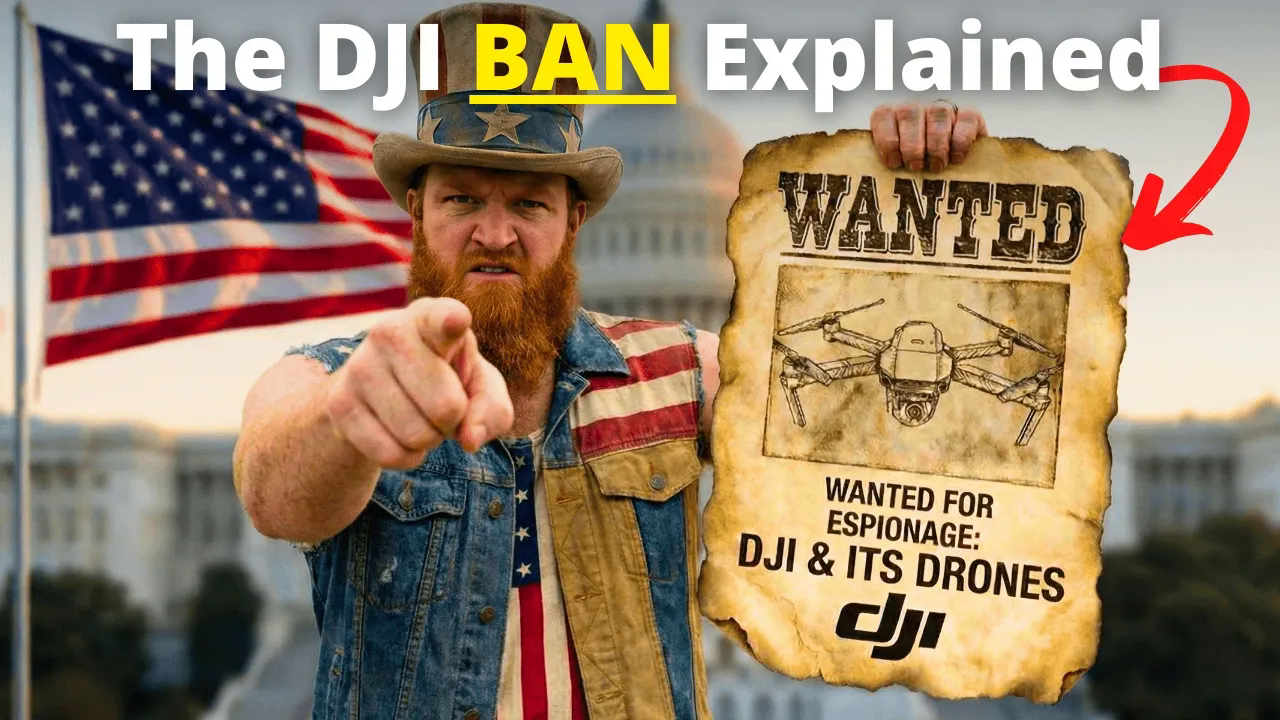
This article is a guest-written piece adapted from a video by Dylan Gorman. Dylan dives deep into practical uses such as drone mapping, photogrammetry, and inspections, providing clear insights into how these cutting-edge tools are transforming various industries. You can find more of Dylan’s work on his YouTube channel and his website pilotbyte.com. Readers will also find comprehensive guides, expert reviews, and a broad perspective on the rapidly evolving drone landscape.

If you’ve heard that DJI drones are about to be banned in the US, you might be feeling a wave of panic. You’re not alone. Many drone operators are worried and confused. But here’s the truth you need to hear right now.
No, your DJI drone isn’t going to crash land on December 23rd.
DJI is not currently banned. At least not yet. Your drone will not stop working on December 23rd. It will not fall from the sky. This isn’t going to be like Y2K, when people thought every computer on Earth would shut down at midnight on January 1, 2000. That didn’t happen. And this won’t either.
But there is a reason people are worried. A very specific default ban mechanism is tied to December 23rd. This has created confusion. People are trying to piece together information from many different sources. Some of what they’re hearing is true. Some is proposed. And some absolutely isn’t happening.
This article brings everything into one place. We’ll explain what’s real and what’s not. We’ll look at the facts about the FCC, the covered list, and what Congress is considering. We’ll explore the security concerns that started this debate. We’ll examine the lobbying efforts on both sides. And we’ll help you understand exactly where things stand today.
You’ll learn whether your drone is actually at risk. You’ll understand what December 23rd really means. And you’ll know what practical steps you can take right now. This is about separating fear from reality and giving you the clear information you need to make informed decisions as a drone operator.
How the FCC Regulates Drones and Equipment Authorizations

The proposed ban on DJI drones is directly linked to the FCC. Understanding how this agency works is key to understanding the entire situation.
The Federal Communications Commission (FCC) is a government agency. It regulates all communication infrastructure in the United States. This includes radio, television, internet, satellites, and wireless systems. The FCC does not control airspace or flight rules. That’s the FAA’s job. But the FCC plays a crucial role in whether drones can legally operate.
The FCC oversees the wireless components inside drones. This includes radio transmitters, receivers, and video transmission systems. These parts are used for remote control and live video feeds. Without them, a drone cannot function properly.
Every drone in the US must receive an FCC equipment authorization to legally operate its wireless communication systems.
This authorization is required before a drone can be sold, marketed, or activated for legal use. If a drone lacks this approval, it cannot legally operate in the United States. This is where the FCC’s power becomes clear.
In 2021, the FCC created the covered list. This list includes companies that are considered threats to national security. Companies like Huawei and ZTE were added to this list in early 2021. The consequences are serious.
Once a company is on the covered list, the FCC is prohibited by law from approving any new products from that company. That’s why we haven’t seen any Huawei or ZTE products since 2021. The ban is automatic. It happens by default. And it’s this same mechanism that could affect DJI drones.
DJI’s Status, Covered-List Implications, and the “Default” Ban Mechanism

The FCC covered list is not just a warning label. It’s a legal barrier with real consequences. When a company lands on this list, it means the government views it as a threat to national security. And the effects are immediate and severe.
Once a company is on the covered list, the FCC is prohibited by law from approving any new products from that company.
This is the key point. The FCC cannot approve new wireless equipment from companies on the covered list. No exceptions. No negotiations. The law simply blocks them.
For DJI, this creates a very specific situation. All existing DJI drones that already have FCC certification remain legal to fly. Your current drone is not affected. You can continue using it. DJI can also continue supporting these older models for now. Software updates, repairs, and customer service can all continue.
But here’s what changes. DJI cannot introduce any new drones into the US market. They also cannot get approval for major hardware updates that require new FCC certification. Even small changes to wireless components might need re-approval. And if DJI is on the covered list, that approval will not come.
Think of it like this. The FCC acts like a wireless TSA. Just as airport security decides who can board a plane, the FCC decides which devices can operate on American airwaves. If a company is flagged as a security concern, its new devices won’t even make it past the gate.
Right now, DJI has not been officially added to the covered list. But it is on the chopping block. It faces what’s called a “default ban mechanism.” This means DJI could be added automatically unless action is taken to prevent it. That’s where December 23rd comes in. And that’s why so many people are concerned.
There are only two ways DJI can avoid this fate. First, DJI could be removed from consideration for the covered list entirely. Second, DJI could be granted a specific exemption. Both options require action from Congress or the FCC. Without one of these steps, the default ban will take effect. And once it does, no new DJI products will be approved for use in the United States.
Congressional Pressure, Key Bills, and the NDAA Deadline

The push to restrict DJI drones in the United States comes from Congress. This isn’t a sudden decision. It’s the result of growing concerns about Chinese technology and national security. These concerns have gained support from both major political parties. Democrats and Republicans alike have expressed worry about Chinese companies operating in sensitive areas.
Representative Elise Stefanik has been one of the most visible leaders of this effort. She has backed several bills aimed directly at limiting DJI’s presence in the US market. One of the key pieces of legislation is the Countering CCP Drones Act. This bill seeks to designate DJI as a security risk. It would place DJI on a federal restriction list. Once on that list, DJI’s future products would be blocked from gaining the approvals needed to operate legally in the United States.
The argument behind these bills is straightforward. DJI is headquartered in China. Under Chinese law, companies can be compelled to share data with the Chinese Communist Party. Lawmakers worry that DJI drones operating in sensitive US environments could create vulnerabilities. They fear that data collected by these drones could be accessed by the Chinese government. This includes video footage, location data, and flight patterns.
These legislative efforts came together in Section 5949 of the FY2023 National Defense Authorization Act, known as the NDAA. This section includes a very specific mechanism. It sets a statutory deadline of December 23, 2025. This is the date that has created so much confusion and concern in the drone community.
If no US agency completes a formal security review of DJI by December 23rd of 2025, the company will be blocked from receiving new authorizations, resulting in a de facto ban on new DJI products.
Here’s how the mechanism works. Unless a formal security review is completed by a US agency before the deadline, DJI will automatically be blocked from receiving new FCC authorizations. This is what people mean when they call it a “ban by inaction.” No vote is needed. No additional legislation is required. The ban happens by default if nothing is done.
Critics of this approach call it unfair. They argue that DJI is being punished without a proper review of the evidence. They say the burden of proof should be on the government to show that DJI is actually a threat. Instead, the NDAA clause assumes guilt unless proven otherwise.
Supporters see it differently. They call it a precautionary safeguard. They argue that waiting for proof of harm could be too late. They believe that blocking DJI now protects national security while a proper review takes place. They point to the fact that other Chinese companies, like Huawei and ZTE, have already been restricted under similar concerns.
The December 23rd deadline is now less than a year away. No formal security review has been completed yet. No agency has stepped forward to conduct one. And without that review, the default ban mechanism will activate. DJI will be added to the covered list. And no new DJI products will be approved for use in the United States.
Security History — 2017 Research, Vulnerabilities, and DJI’s Response

The security concerns around DJI are not new. They date back several years. One event in particular amplified these worries and shaped the conversation we’re having today.
In 2017, researcher Kevin Fininser uncovered significant vulnerabilities in DJI’s cloud infrastructure. His findings were serious. They included unencrypted flight logs, exposed user data, and developer keys that could have been accessed by anyone. These were not small oversights. They were technical weaknesses in systems that thousands of users relied on every day.
Fininser tried to report these issues through DJI’s bug bounty program. This is a standard process where security researchers disclose problems privately to a company before going public. But disagreements arose over non-disclosure terms. Unable to reach an agreement, Fininser published his findings publicly instead.
His report did not claim that DJI was engaging in espionage, but it did reveal several technical weaknesses that could hypothetically be exploited.
This is a critical distinction. Fininser did not accuse DJI of spying or intentional wrongdoing. He simply pointed out that the systems had gaps. These gaps could, in theory, be exploited by someone with bad intentions. Whether that ever happened is a separate question. But the potential was there.
These findings did not stay buried in technical reports. They were later cited in congressional conversations, policy briefings, and national security discussions. Lawmakers used them as evidence that DJI systems had insufficient protections at the time. This was especially concerning because DJI drones were widely used by police departments, critical infrastructure teams, and emergency response units. These are sensitive environments where data security matters most.
Since 2017, DJI has made many updates. The company has consistently rejected accusations that it poses a security threat to the United States. DJI maintains that it is privately owned, not government controlled. It has repeatedly asserted that it does not share data with any government, including China.
DJI also points to features it has introduced to address security concerns. One example is Local Data Mode. This feature fully disconnects a drone from outside communications. It ensures that no data is transmitted over the internet during flight. Third-party audits have also been conducted. These audits found no evidence of forced data transmission or intentional backdoors.
DJI has publicly welcomed a full US government security review. The company says it is willing to cooperate with whatever agencies may lead one. To date, no such review has been completed. This leaves DJI in a difficult position. Its future in the US market does not depend only on a technical evaluation. It also depends on whether Congress and federal regulators act before the statutory deadline.
DJI has repeatedly said it wants transparency and an evidence-based assessment. The company notes that it has never marketed its products for military use. It also states that it does not collect data without user consent. These are DJI’s words. Whether they are enough to satisfy lawmakers remains to be seen.
Lobbying and Industry Dynamics — Skydio, DJI, and Influence

Behind the scenes, lobbying has shaped much of the conversation around DJI and drone policy. This influence comes from both sides. It’s not just one company pushing one agenda. Multiple players are involved. Each has its own goals. And each has invested significant resources to make its voice heard.
Skydio is one of the leading US drone manufacturers. The company has invested heavily in advocacy. Its focus is on domestic-first procurement, higher cybersecurity standards, and restrictions on foreign-made drones used by government agencies. Between 2020 and 2023, Skydio spent approximately $1.7 million on lobbying at both federal and state levels.
One example of Skydio’s influence can be seen in Florida. The company’s advocacy contributed to restrictions on foreign-made drones used by police agencies. These restrictions do not apply to private entities. They target public safety departments specifically. Skydio publicly frames its involvement as an effort to strengthen American innovation, improve supply chain resilience, and ensure secure technology for public safety and defense.
Skydio has not explicitly called for a blanket ban on DJI. But the policies it supports naturally shift government demand toward US-made systems. This means demand shifts away from competitors like DJI. The effect is clear. When government agencies are required to buy domestic drones, Skydio benefits directly.
DJI has responded by significantly expanding its own lobbying presence. Facing mounting legislative and regulatory pressure, the company has ramped up its efforts in Washington.
Between 2020 and 2024, the company spent an estimated $7.4 million on federal lobbying, hiring major Washington consulting firms, former congressional staffers and even former US Attorney General Loretta Lynch.
This is a substantial investment. DJI has hired major Washington consulting firms. It has brought on former congressional staffers who understand how legislation moves through Congress. It has even enlisted former US Attorney General Loretta Lynch. These are high-profile names with deep connections in government.
DJI has also supported the Drone Advocacy Alliance. This group mobilizes drone operators who rely on DJI products. It pushes back against proposed restrictions. The alliance argues that a ban would harm thousands of small businesses, first responders, and professionals who depend on DJI drones for their work.
The result is a lobbying battle on two fronts. On one side, Skydio and other domestic manufacturers push for policies that favor US-made drones. On the other side, DJI and its supporters fight to keep access to the US market open. Both sides claim they are acting in the public interest. Both sides have spent millions of dollars to make their case.
This dynamic raises important questions. How much of the push to restrict DJI is based on genuine security concerns? And how much is driven by competitive interests? The answer is likely a mix of both. But it’s clear that lobbying has played a major role in shaping the debate. And it will continue to influence what happens next.
Community Reaction — Divided Industry, Pros and Cons, and the Demand for Evidence

The drone community is deeply divided over the potential DJI ban. Reactions vary widely depending on who you ask. Commercial operators, independent filmmakers, hobbyists, and small businesses often have one view. Defense contractors, public safety agencies, and national security analysts often have another. The split is not just about politics. It’s about practical realities, economic impacts, and what evidence actually exists.
Many commercial operators, independent filmmakers, hobbyists, and small businesses view DJI as the most capable and cost-effective solution available and see the ban as politically motivated, economically disruptive or lacking clear evidence.
Many who oppose the ban point to a simple fact. There is no definitive proof that DJI has misused data or engaged in espionage on behalf of the Chinese government. They argue that policy should be based on evidence, not assumptions. Without clear proof of wrongdoing, they see the ban as unfair. They also worry about the economic consequences. Thousands of businesses rely on DJI drones every day. These drones are used for inspections, mapping, filmmaking, agriculture, and emergency response. Losing access to new DJI products would force many operators to switch to more expensive alternatives. Some fear they may not be able to afford those alternatives at all.
On the other side, supporters of the ban take a different view. They include some defense contractors, public safety agencies, and national security analysts. These groups believe it is safer to move away from foreign-made systems now, before theoretical risks become real. They argue that waiting for proof of harm could be too late. They point to the fact that Chinese law allows the government to compel companies to share data. Even if DJI has not been caught doing so, the potential exists. For these supporters, the precautionary principle applies. Better safe than sorry.
But even among supporters of restrictions, there is acknowledgment of a problem. Domestic systems are often more expensive, less capable, or less mature than DJI counterparts. This creates a dilemma. If DJI is banned, what will replace it? Will those replacements be affordable? Will they meet the needs of operators who depend on advanced features like obstacle avoidance, long flight times, and high-quality cameras? These are real questions without easy answers.
There is one area where many on both sides agree. The need for clear evidence and a formal security review. Many in the community, regardless of their position on the ban, believe that decisions of this scale should be based on transparent assessments. They want to see the data. They want to know what risks are real and what risks are theoretical. They want a process that is fair, open, and based on facts. So far, no such review has been completed. And without it, the debate continues to be driven more by assumptions and lobbying than by hard evidence.
The Presenter’s Perspective — Private Choice vs. Government Procurement

The debate over DJI drones has created confusion. Many operators don’t know where they stand. Some wonder if they should panic. Others wonder if they should act now. But the situation requires a balanced view. It requires separating what the government should do from what private citizens should be allowed to choose.
Government Use: A Logical Security Decision
From a national security standpoint, the federal government’s position makes sense. Government agencies handle sensitive operations. They work with classified information, critical infrastructure, and law enforcement. In these environments, the origin of technology matters.
Russia doesn’t use US-made systems for sensitive work. China doesn’t either. So why should the United States rely on foreign-made drones for its most critical operations? This is a fair question. It’s reasonable for the government to want control over the tools it uses in defense, intelligence, and public safety.
Transitioning to domestically built systems for military, law enforcement, and critical infrastructure work is the right move. It reduces potential vulnerabilities. It supports American manufacturing. And it gives the government more oversight over the technology it depends on. This is not about banning DJI entirely. It’s about making smart choices for sensitive use cases.
Private Sector: The Case for Freedom of Choice
But here’s where the situation becomes more complicated. Government procurement decisions should not automatically dictate what private operators can use. Private companies, independent filmmakers, hobbyists, and small businesses operate in a different world. They are not handling classified data. They are not flying over military bases. They are inspecting roofs, filming weddings, mapping construction sites, and running agricultural surveys.
We need to separate government level security decisions from private sector freedom of choice.
Just like Americans have the freedom to choose whatever phones or computers they want to buy, they should also have the freedom to choose the drones they want to operate. Especially in the private sector. The government can set its own procurement rules. But forcing private operators to switch systems is a different matter entirely.
The Financial Reality for Private Operators
Many private operators have invested heavily in DJI systems. Some have spent tens of thousands of dollars. Others have invested even more. These are not casual purchases. They are business decisions. Drones are tools that generate income. They are part of a larger ecosystem that includes batteries, controllers, software, training, and workflows.
Switching to a different platform is not simple. It’s expensive. A comparable US-made system can cost $10,000 to $20,000 or more. For a large operation, that might be manageable. But for a small business or independent operator, it’s a serious financial burden. And it’s not fair to force that burden on people simply because the government wants to change what it uses internally.
A Balanced Approach
The right approach separates these two worlds. The government should absolutely move toward domestic systems for sensitive operations. That’s a reasonable security decision. But private operators should retain the freedom to choose the tools that work best for their business. As long as they are not working on sensitive government contracts, they should not be subject to the same restrictions.
This is where policy should focus. Create clear rules for government procurement. Support the growth of domestic drone manufacturers. But don’t impose blanket bans that punish private citizens and businesses for choosing cost-effective, capable tools. That’s where the line should be drawn.
Practical Advice for Private Operators
If you’re a private operator, here’s what you should do. First, evaluate your own risk. Are you working with sensitive data? Are you flying near critical infrastructure? If not, your risk profile is likely low. Second, budget for redundancy if you can. Having a backup system from a different manufacturer gives you flexibility. It also protects you if regulations change. Third, stay informed. Follow updates from the FCC, Congress, and industry groups. The situation is evolving. And the more you know, the better decisions you can make.
The key takeaway is this. Government-level security decisions are important. But they should not automatically override private-sector freedom of choice. Both can coexist. And both should be respected.
The December 23 Deadline, Current Reality, and Immediate Choices

December 23rd is approaching fast. The US drone landscape could look very different moving into 2026. But right now, you have options. And you need to understand what’s real and what you can actually do.
Existing Systems Remain Legal
Here’s the most important thing you need to know. If the de facto ban does go into effect as currently written, the systems you buy right now will still be completely fine to keep flying. This is not speculation. This is how the mechanism works.
Anything already in the US remains unaffected.
The proposed ban targets new FCC authorizations. It does not target drones that are already authorized and already in circulation. Think about it. There are over half a million DJI drones already in use across the United States. These drones are not suddenly going to stop working. They will not break themselves at midnight like some Y2K reset button. That’s not how this works.
Historically, the FCC has never retroactively revoked active authorizations. Although the agency recently gained the power to do so, grounding half a million drones would be enormous and avoidable. Many of these drones are still used daily by first responders, inspectors, and small businesses. Shutting them all down would create chaos. It would harm public safety. And it would face massive legal and practical challenges.
Buy Before the Deadline
If you’re concerned about the future, now is the time to act. Systems purchased before December 23rd should remain legal to operate. This includes consumer models like the Mini 5 Pro and the Neo 2. It also includes enterprise models like the M400. These systems come with FCC authorization already in place. Once that authorization is granted, it stays with the device.
Many operators are making purchases now to secure their equipment before the deadline. This is a practical step. It gives you the tools you need without waiting to see what happens. If the ban goes into effect, you’ll still have access to the systems you rely on. If the ban is delayed or prevented, you’ll have the latest equipment either way.
When purchasing, consider working with a trusted vendor. Reliable vendors ensure you receive systems with proper documentation, warranty support, and timely delivery. This matters more than ever as the deadline approaches. You want proof of purchase. You want confirmation that your system was authorized before any restrictions take effect.
Inventory Your Current Equipment
Take stock of what you already own. Make a list of every DJI drone, controller, battery, and accessory you have. Document the serial numbers. Keep your receipts. Save proof of purchase and FCC certification. This documentation may become important if questions arise later about when your equipment was acquired.
If you rely on DJI systems for your business, consider whether you have enough redundancy. Do you have backup drones? Do you have spare batteries and controllers? Do you have the parts you need to keep your systems running for the next few years? Now is the time to fill those gaps.
Maintain Firmware and Updates
DJI has not indicated that it will stop supporting existing systems. Software updates, repairs, and customer service should continue for drones already in circulation. But it’s still smart to stay current. Make sure your firmware is up to date. Download the latest versions of DJI’s apps. Save copies of software and manuals in case access becomes limited in the future.
Local Data Mode is another feature worth understanding. This mode fully disconnects your drone from outside communications. It ensures that no data is transmitted over the internet during flight. If privacy or security is a concern, this mode gives you full control.
Consider Warranty and Support Plans
If you’re purchasing new systems now, think about extended warranty and support plans. These plans can provide repairs, replacements, and technical assistance for years to come. If new DJI products become unavailable after December 23rd, having a strong support plan will be even more valuable.
Some vendors offer additional services like priority support, expedited shipping, and training. These services can make a big difference if you rely on your drones for income. They give you peace of mind. And they help you keep flying even if the market changes.
The Bottom Line
The December 23rd deadline is real. But it does not mean your current drones will stop working. It does not mean you have to panic. It means you should act now if you want to secure new systems before potential restrictions take effect. Inventory your equipment. Prioritize purchases if you’re concerned. Maintain your firmware and updates. And document everything. These are practical steps you can take today to protect your investment and your business.
The Three Realistic Outcomes — Extension, Divestiture, or Ban

The December 23rd deadline is real. But what happens next is not set in stone. There are three realistic outcomes. Each one leads to a different future for DJI operators in the United States. Understanding these outcomes helps you prepare. It helps you make smart decisions. And it helps you plan for what might come next.
So, there are really three possible outcomes here.
Outcome A: Deadline Extension
The first possibility is that the deadline gets extended. The government has pushed deadlines like this before. It could happen again. This would allow time for an actual security review instead of a default automatic ban.
An extension would give federal agencies the chance to conduct a proper assessment. It would allow DJI to present evidence. It would give Congress time to review findings and make an informed decision. This is the outcome that many in the drone community hope for. It would prevent a rushed decision based on assumptions rather than facts.
If this happens, operators should monitor announcements closely. Watch for updates from the FCC, Congress, and industry groups. Defer major investments until clarity emerges. An extension buys time. But it doesn’t solve the problem permanently. The review could still conclude that DJI poses a risk. Or it could clear the company. Either way, an extension means the situation remains uncertain for longer.
Recommended operator actions for Outcome A:
- Monitor official announcements from the FCC and Congress.
- Defer major equipment investments until clarity emerges.
- Continue using existing systems without concern.
- Stay connected with industry groups for updates.
Outcome B: Divestiture Model (TikTok-Like)
The second possibility mirrors what happened with TikTok in 2025. TikTok avoided a nationwide US ban by agreeing to a forced divestiture. It shifted its American operations into a new US-controlled entity. This entity has majority American ownership, US-based servers, and oversight from a US board and cloud provider. The move effectively removed national security concerns tied to foreign control. But it allowed the platform to remain available in the United States.
DJI could follow a very similar path. It could establish a truly US-based subsidiary with American majority ownership. It could reallocate data, firmware oversight, and radio communication compliance to US soil. It could create a firewall between the Chinese parent company and all US manufacturing code and telemetry systems.
A structure like this would give the US government the oversight it demands. It would allow DJI hardware to continue operating legally in the American market. Many believe this would be the smartest play for DJI. It would avoid the ego match that both countries are currently playing. And it would protect the thousands of operators caught in the middle.
If this outcome happens, operators should assess compliance changes carefully. Watch for product re-certifications. New models may require updated FCC authorizations under the new structure. Existing systems should remain unaffected. But future purchases may involve slightly different processes or branding.
Recommended operator actions for Outcome B:
- Assess compliance changes and new ownership structure.
- Watch for product re-certifications and updated FCC authorizations.
- Understand how data handling and firmware updates may change.
- Continue using existing systems with confidence.
Outcome C: Full Ban (De Facto)
The third possibility is that nothing changes. No extension is granted. No divestiture is negotiated. The December 23rd deadline passes. And the default ban mechanism activates. This means no new DJI systems can be marketed or sold in the United States.
This is the scenario that worries operators most. But even in this case, existing systems remain legal to fly. The ban targets new FCC authorizations. It does not target drones already in circulation. Your current equipment will not stop working. DJI can continue supporting existing models. Software updates, repairs, and customer service should continue.
But the future becomes much harder. DJI cannot introduce new models. It cannot get approval for major hardware updates. Over time, the technology will age. Competitors will catch up. And operators will face pressure to migrate to domestic alternatives.
If this outcome happens, operators need to plan migrations carefully. Budget for replacements. Evaluate domestic alternatives for critical workflows. Consider the long-term sustainability of your equipment. And make decisions based on your specific business needs.
Recommended operator actions for Outcome C:
- Plan migrations to alternative platforms if needed.
- Budget for replacements and evaluate domestic options.
- Assess which workflows are most critical and prioritize accordingly.
- Maintain existing DJI systems as long as they remain functional and supported.
Comparative Checklist for Each Outcome
No matter which outcome occurs, operators need to think through the same key questions. Here’s a checklist to help you evaluate the impact on your business.
Business Impact:
- How many DJI systems do you currently own?
- How critical are these systems to your daily operations?
- What is your budget for potential replacements?
- Do you have backup systems from other manufacturers?
Procurement Timelines:
- Are you planning to purchase new systems in the next 12 months?
- Can you afford to wait for clarity before making major purchases?
- Do you need to secure equipment before December 23rd?
Compliance Steps:
- Do you have documentation for all your existing systems?
- Are your firmware and software versions up to date?
- Have you explored Local Data Mode or other privacy features?
- Do you understand the FCC authorization status of your equipment?
Data-Handling Considerations:
- Are you working with sensitive data or government contracts?
- Do you need to implement additional security measures?
- Are you comfortable with current data-handling practices?
- Would a US-based subsidiary change your risk assessment?
Each outcome has different implications. But all three require you to stay informed, plan ahead, and make decisions based on your unique situation. The key is to avoid panic. Understand the facts. And take practical steps to protect your investment and your business.
Impacts of a Full Ban and Market Consequences

A full ban on DJI would create immediate and severe consequences for the US drone market. This is not a minor disruption. This is a scenario that would reshape the entire industry overnight. And the effects would be felt most by the operators who depend on affordable, capable systems every single day.
It would devastate the US drone industry overnight and create a massive gap that cannot be patched quickly.
Immediate Market Shock
If no new DJI systems can be marketed or sold in the United States, the impact would be instant. DJI currently dominates the consumer and prosumer drone market. The company holds an estimated 70 to 80 percent market share in the United States. Millions of operators rely on DJI drones for work and recreation. Removing DJI from the market would leave a void that no other manufacturer can fill quickly.
Existing operators would face uncertainty. Parts and accessories could become harder to find. Warranty and repair services might be disrupted. And the resale value of used DJI equipment could drop sharply. Some operators might try to stockpile systems before the deadline. Others might panic and switch to alternatives prematurely. Either way, the market would experience chaos.
The Price and Capability Gap
The most serious problem is the price gap. The bulk of private drone operators live in the $1,000 to $5,000 price range. This is where DJI has excelled. Models like the Mini series, the Air series, and the Mavic series offer advanced features at accessible prices. They include obstacle avoidance, long flight times, high-quality cameras, and intelligent flight modes. These features are not luxuries. They are essential tools for professionals who use drones for inspections, mapping, filmmaking, and agriculture.
US manufacturers have not yet matched DJI in this price range. Skydio, for example, produces excellent drones. But its systems are priced higher. They target enterprise and government customers. They are not designed for the average hobbyist or small business owner. Other US manufacturers face similar challenges. They cannot yet produce systems with the same combination of features, reliability, and affordability that DJI offers.
This gap would leave thousands of operators without viable options. They would face a difficult choice. Pay significantly more for a domestic alternative. Or stop flying altogether. For many small businesses, neither option is sustainable.
Short-Term Inability to Scale
Even if US manufacturers wanted to fill the gap quickly, they could not. Scaling production takes time. It requires investment in manufacturing facilities, supply chains, and workforce training. It requires testing, certification, and quality control. These processes cannot be rushed without sacrificing quality or safety.
DJI has spent years building its infrastructure. It has factories, suppliers, and distribution networks around the world. It produces hundreds of thousands of drones every year. US manufacturers are not at that scale yet. And they will not reach it overnight. A sudden ban would create a supply shortage that could last for years.
Potential Winners and Losers
Some companies would benefit from a DJI ban. Skydio is the most obvious example. The company would gain market share, especially in government and enterprise sectors. Other US manufacturers, like Autel Robotics, might also see increased demand. But these companies would struggle to serve the entire market. They do not have the capacity to replace DJI’s volume. And they do not offer products at every price point.
The real losers would be the operators. Small businesses that rely on drones for income would face higher costs and fewer options. Hobbyists would lose access to affordable systems. First responders and public safety agencies would need to find alternatives quickly. And the overall growth of the US drone industry would slow. Innovation would suffer. Investment would decline. And the United States would fall further behind in a technology sector it once led.
Long-Term Considerations
In the long term, a DJI ban could have positive effects if handled correctly. It could accelerate investment in domestic supply chains. It could create incentives for US manufacturers to innovate and compete. And it could strengthen national security by reducing dependence on foreign technology.
But these benefits would take years to materialize. And they would only happen if the government provides support. This includes funding for research and development, tax incentives for manufacturing, and policies that encourage competition. Without this support, a ban would simply create a vacuum. And that vacuum would harm the very industry it was meant to protect.
The bottom line is clear. A full ban on DJI would devastate the US drone market in the short term. It would create a massive gap that cannot be filled quickly. And it would hurt the operators who depend on affordable, capable systems every day. This is the scenario that many in the drone community hope to avoid.
Conclusion, Call for Evidence-Based Review, and Community Engagement
The deadline is fast approaching. December 23rd will arrive soon. And while the future remains uncertain, one thing is clear. This situation affects thousands of drone operators across the United States. It affects small businesses, hobbyists, filmmakers, inspectors, and first responders. These are the people caught in the middle of a political chess game between powerful figures and competing interests.
This isn’t about taking sides. It’s about giving you guys a very high-level fact-based overview of what’s happening and why.
This article has covered the major points. We’ve explained how the FCC regulates drones and equipment authorizations. We’ve examined the covered-list mechanics and how the default ban mechanism works. We’ve explored the NDAA deadline and what it means for DJI. We’ve reviewed the historical security concerns from 2017 and how DJI has responded. We’ve looked at the lobbying dynamics between Skydio, DJI, and other players. And we’ve outlined the three realistic outcomes and their potential impacts on the market.
The reality is simple. The federal government has legitimate concerns about national security. It makes sense for government agencies to move toward domestic systems for sensitive operations. But private-sector operators should retain the freedom to choose the tools that work best for their business. These two positions are not mutually exclusive. They can coexist. And they should be separated in policy.
What’s missing from this entire debate is a formal, transparent, evidence-based security review. Without one, decisions are being made based on assumptions, political pressure, and competitive interests. That’s not how policy should work. Operators deserve to see the data. They deserve to know what risks are real and what risks are theoretical. And they deserve a process that is fair, open, and based on facts.
The community is divided. Some support restrictions. Others oppose them. But many on both sides agree on one thing. The need for clear evidence and a proper review. That review has not happened yet. And without it, the debate will continue to be driven more by lobbying and politics than by hard evidence.
Now is the time for optimism and preparedness. Stay informed. Follow updates from the FCC, Congress, and industry groups. Take practical steps to protect your investment. Inventory your equipment. Secure new systems if you need them. Maintain your firmware and updates. And document everything.
The drone community has a voice. Use it. Share your thoughts. Engage constructively in public discussions. Provide evidence if you have it. Support policies that balance security with freedom of choice. And encourage lawmakers to base their decisions on facts, not fear.
The political stakes are high. But the operators caught in the middle deserve better. They deserve transparency. They deserve fairness. And they deserve a process that respects both national security and private-sector freedom. That’s the standard we should all be pushing for as December 23rd approaches.